AI-Driven Individual Learning Pathways in K-12 Education
- Deebak Barathan
- July 8, 2026, 6:04 p.m.
K-12 learning is reshaped by AI through building personalised learning pathways that align to each child's learning stage, specific abilities and goals. AI assists educators in providing more engaging and individualised learning experiences while allowing educators to concentrate on student growth and mentoring through various insights.
The blog explores the emerging applications, implementation challenges and benefits of AI-driven individualised learning, stressing the value of teacher training, equitable access and ethical use. It serves as a potential partner in creating student-centred classrooms that are ready for the future success of every student.
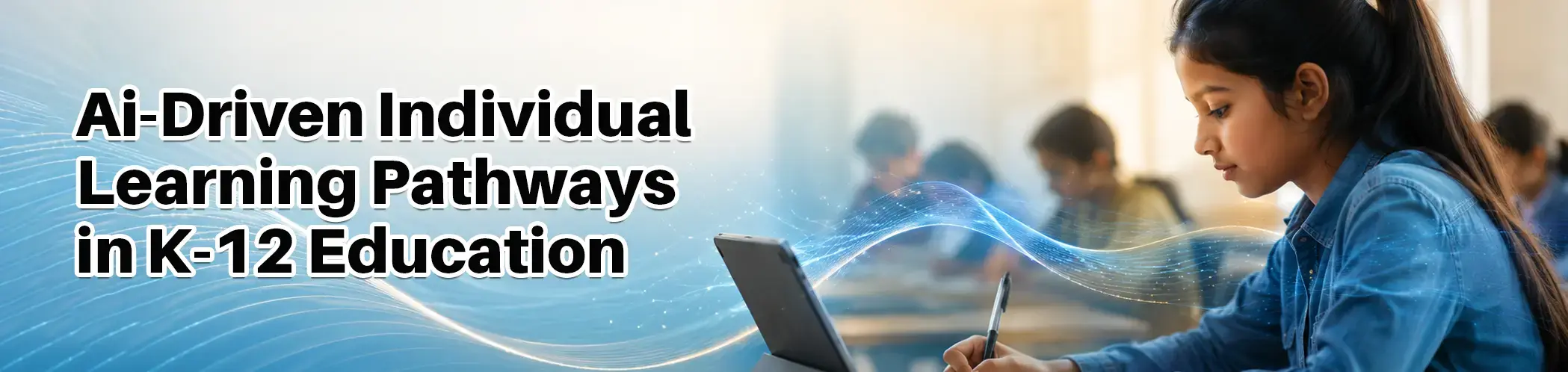
Schools have offered all children an education customised to their specific interests, strengths, and ambitions for decades. Various learning requirements, limited teacher time, and big classrooms have made true individualisation hard to accomplish.
Artificial Intelligence (AI) is empowering educators to build personalised learning pathways that align with each learning style, academic goals and students' progress instead of replacing teachers. AI is making personalised learning more efficient, inclusive and scalable.
AI-driven educational pathways are increasing as one of the most impactful inventions in advanced learning as K-12 schools undergo a digital shift throughout the world.
What Is AI-Driven Individual Learning Pathways?
AI-driven personalised education pathway is an individualised learning method that gets adjusted to a child's learning speed, interests, preferences, current knowledge, skill level, educational goals, assessment performance, engagement patterns, strengths and weaknesses.
Technology examines learning information and advocates the most suitable stage for each student continuously, unlike traditional classrooms where every learner follows a similar lesson pattern.
For instance, a learner struggling with fractions may get additional explanations and interactive practice. Another learner who has mastered it can soon proceed to more advanced concepts. This builds a real adaptive educational ecosystem where every learner moves at their own pace.
Why Individualised Learning Matters More?
Students have different interests, abilities, and preferences. Some students prefer learning by reading books, learning by videos, need rewarding options, require repeated practice, and need extra support with project-based education. Usual education methods often struggle to meet all these requirements.
Artificial Intelligence is bridging this void by enabling teaching that is information-driven, personalised, and result-oriented, while permitting educators to concentrate on significant communications with children. Professionals stress that AI is most efficient when it improves teacher expertise in education as well.
How Does AI Build Personalised Learning Pathways?
Finding Learning Gaps: AI immediately identifies concepts children find more challenging. Mentors get actionable guidance rather than examining assessment data manually for hours. AI can shift huge volumes of student performance information into instructional data that support timely treatment.
Continuous Assessment: AI tools track student learning through practice activities, quizzes, digital interactions, classroom participation, project submissions and homework rather than relying only on periodic assessments.
Individualised Level: AI's greatest potential is permitting children to study without unnecessary pressure; rather than forcing a whole class to move uniformly. Students requiring additional guidance get more time, students revisit hard concepts whenever needed, and quick learners improve faster.
Real-Time Response: Quick response is one of the steadiest drivers of efficient education, and AI can immediately provide hints, explain mistakes, suggest enhancements, track mastery levels and encourage additional practice. Students no longer need to wait days for a response before setting misunderstanding.
Adaptive Content Delivery: As the education gaps are discovered, AI advocates relevant study materials like reading resources, interactive videos, audio-based lessons, practice exercises, educational games, simulations, and visual explanations. Children get educational experiences that match both their preferred learning style and understanding.
Why Does the Teacher's Role Become Even More Essential?
A general understanding is that AI substitutes teachers, and successful AI integration fortifies their role in real ways. Teachers can dedicate more time to facilitate discussions, mentoring children, fostering creativity, promoting collaboration, building up critical thinking and supporting emotional health.
It is useless to spend hours creating distinguished worksheets, ranking assignments, preparing multi-lesson versions, or examining execution reports. Education should stay humanistic with AI to increase teacher expertise instead of substituting it - KnowledgeWorks.
What Are the Advantages of AI-Driven Personalised Learning Pathways?
-
- Forward-thinking Academic Accomplishment: Individualised learning cuts down knowledge disruptions before they become substantial concerns. Continuous tracking assists children in mastering concepts before improvement.
- Better Student Participation: Children stay more motivated when lessons adjust with their current abilities and interests. Adaptive content keeps studying suitably challenging.
- More Comprehensive Classrooms: Children with varied learning requirements, along with multilingual learners, benefit from individual guidance like varied content formats, tailored scaffolds and translated materials.
- Data-Informed Instruction: Mentors get quick access to classroom execution, education trends, intervention advice, examination analytics and individual growth.
- Increased Engagement: AI enables children to set individual goals, reflect on their accomplishments, select learning activities and track their progress, promoting learning habits and independence in the long term.
What are the Emerging AI Tools Supporting Individualised Learning?
K-12 institutions are incorporating AI into their learning ecosystem, and the latest applications involve brilliant lesson planning, AI instructing assistants, language translation guidance, adaptive assessments, automated feedback models, interactive learning companions and lecture summaries.
Some institutions employ AI-driven classroom technologies that enable children to interact in the classroom, generate tailored study resources and revisit recorded lessons.
What are the Problems Schools Must Address?
-
- Access and Equity: Children do not have access to individualised devices, authentic internet options and digital learning ecosystems.
- Protected data: Institutions must ensure that student data remains safe and follows privacy policies.
- Ethical Usage: Proper policies concerning academic integrity, AI usage, bias moderation, and student interactions are required for schools.
- Educator Coaching: Professional development to incorporate AI into classroom instruction, as successful execution relies on teacher assurance, is required for educators.
How will individualised learning look in K–12 schools by 2035?
The K-12 education future is transforming toward responsive and intelligent learning environments. Rising developments include predictive analytics for early intervention, 24/7 AI-powered learning companions, hyper-curriculum recommendations, multimodal learning experiences, and integration with collaborative and project-based learning.
Latest school systems are mixing AI instruction with project-based learning and small-group instruction, showing how human guidance and technology can work to improve student outcomes.
Final Thoughts about use of AI to Personalise Learning.
AI-controlled personalised education pathways are defining individualised learning by making it practical, and it strengthens schools to meet the specific requirements of every child. Teachers concentrate on what matters most through adaptive teaching, continuous assessment, real-time data and intelligent feedback.
The K-12 education’s future will not be driven by AI alone; it will be influenced by educators who brilliantly employ AI as a partner to build more engaging, student-centred and inclusive classrooms. AI has the potential to assist every child to learn with purpose and confidence when mixed with ethical practices, human connection and strong pedagogy.


Write to our School Consultant: